Why My Atelier Carries Sofonisba’s Name
·
Paulina Ree

I first came across Sofonisba Anguissola many years ago in Frances Borzello’s Seeing Ourselves: Women’s Self-Portraits. I remember the feeling clearly: here was a woman who painted in sixteenth-century Italy, who became famous in her own lifetime, and who placed herself, again and again, at the centre of her own paintings. I had never been taught about her. From that moment she stayed with me.
Since then I have dedicated myself to researching women artists from history, in books and in person, in museums across Europe and North America. And again and again I have found the same story. Women appear on museum walls far more often as subjects than as artists, too often without their clothes. Room after room is filled with battles, conquest and religious scenes, while the stories of women, told by women, are left at the margins or left out completely.
Meeting her work in person
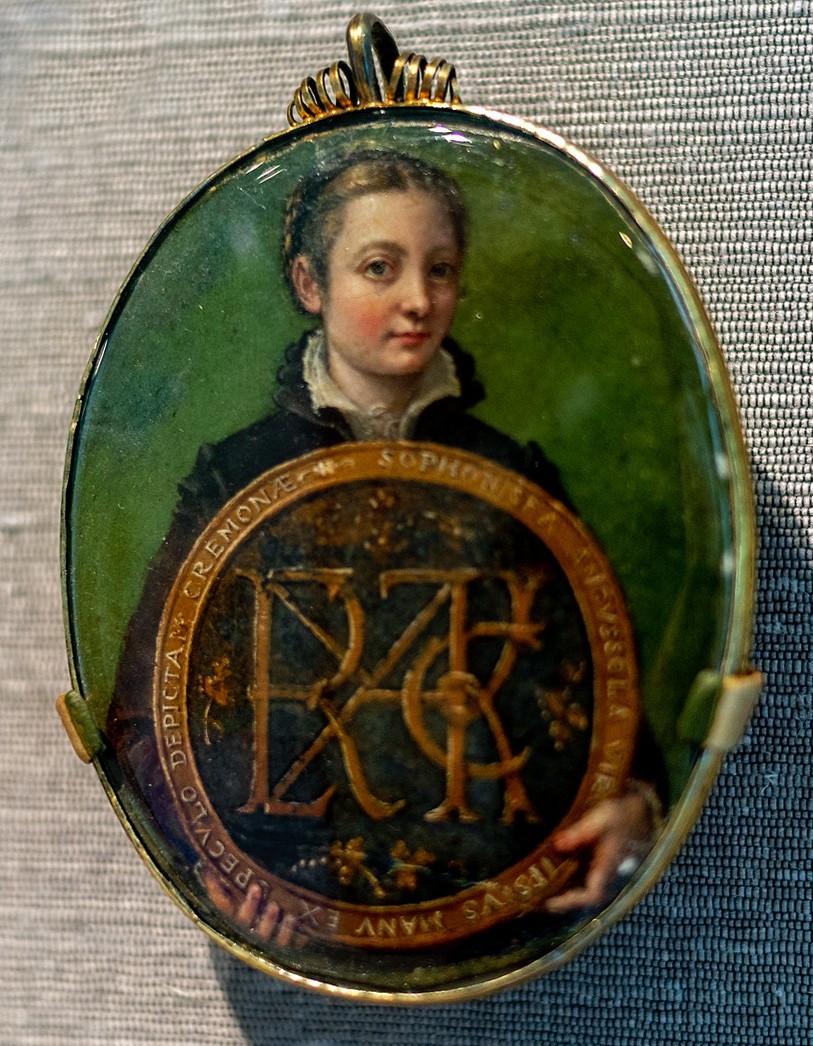
The first time I stood in front of a painting by Sofonisba was at the Museum of Fine Arts in Boston, in the exhibition Strong Women in Renaissance Italy. It was her self-portrait in a medallion from around 1556. The Latin inscription identifies her as the maiden Sofonisba Anguissola, depicted by her own hand, from a mirror, at Cremona. I was grateful to see it, and at the same time disappointed by how small a place she and the other women artists were given in that exhibition. It felt like a tiny taste of her art.
Then, in May 2025, I travelled to the Gemäldegalerie in Berlin with one purpose: to see her portrait of her mother, Bianca Ponzoni Anguissola, from 1557. I spent a whole hour with that painting. I imagined Sofonisba standing at her easel, rendering her mother with a direct gaze, majestic and strong, every fold of fabric and every jewel painted with admiration. I wondered whether she shared the questions I carry as an artist today. How do I find patrons? How do I become visible? How do I remain fully myself, a woman and an artist, at the same time? Most visitors passed by in a few seconds. It was the only work by a woman I could find among perhaps a hundred paintings.
Malerinne in Oslo
This autumn I have been given a gift I never expected: an exhibition at the National Museum here in Oslo, Malerinne, bringing together Sofonisba and her sisters, among them Lucia, Europa and Anna Maria, who also trained as painters. I have visited three times already. This is a rare opportunity, especially to see works from private collections that may not be shown together again in our lifetime, and I warmly encourage everyone to go.

One painting stopped me in my tracks. Bernardino Campi Painting Sofonisba Anguissola (1555–1560, Pinacoteca Nazionale di Siena) shows her teacher at the easel, painting her portrait. In the exhibition it is attributed to Bernardino Campi. The authorship of this work has long been debated by art historians. In her 2024 book on Sofonisba for Lund Humphries’ Illuminating Women Artists series, Cecilia Gamberini presents it as a self-portrait by Sofonisba herself, drawing on Mary Garrard’s influential reading. In that reading, Sofonisba painted herself being painted, larger and more luminous than the master who taught her.


I have written to the exhibition’s curators to ask which evidence underpins the current attribution, and whether the alternative reading could be acknowledged for visitors. I look forward to learning from their response. Questions of attribution matter. For centuries, works by women were credited to men, and every time a painting returns to its rightful author, the history we tell becomes a little more true.
Sofonisba Atelier
This is why my atelier in Bekkestua carries her name. Sofonisba excelled at a time when convention dictated what women could do, especially in public life. She was daring and proud, and she never removed herself from the picture. Sofonisba Atelier is my way of honouring that: a place where women artists, and everyone who wants to create, can make work seriously and be seen.
At the atelier I teach drawing classes in charcoal and pencil, I am opening a quiet daytime studio for working artists, and I run creative sessions for children and their parents, as well as for teams and workplaces. Each of these grows from the same belief that guided Sofonisba: that making art is a way of claiming your place.
If you would like to read more about Sofonisba, you can find my earlier posts about her self-portraits and her portrait of her mother on my Patreon. And if you are in Oslo, go and see Malerinne before it closes on 7 February 2027.

Invitations to openings, secret events, and new works.